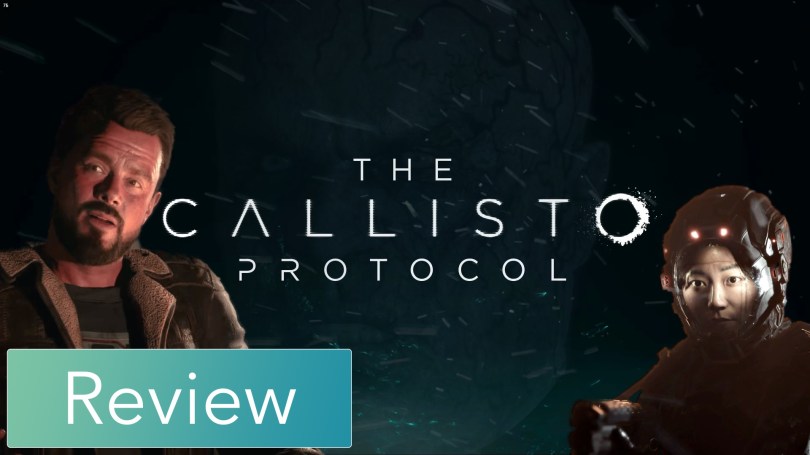
I can already hear the Pristine Decoder rattling in your heads, constructing the question “Of all games, why are you creating a review for this one?”
The simple answer is: because I’ve been trying to create a review for every game I finish since before this channel was a thing.
Your response to that is most likely: “Okay, let me rephrase that. Why’d you play this game in the first place?”
To which I’ll respond with: ‘cause it didn’t cost me anything.
But let’s be serious for a moment, since this is a dark game. Callisto Protocol was a free game in the Epic Games Store on Christmas 2025, and I’m sure you know the adage about the gift horse. Sharp tongues might say that a gift like this is the reason why nobody likes Tim Sweeney’s game store, but that’s besides the point. And believe me, I was also surprised that this commercial flop was presented as the December 24th Mystery Game.
But I didn’t care in that moment because it was undoubtedly a visual treat, even if it had disgusting ingredients. However, this wasn’t stopping me from taking a closer look at it for a Linux Gameplay Performance analysis. After all, Linux supposedly is immune to dangerous viruses and their mutations.
So I attempted a brief Let’s Play series on my German channel, as I need to play a game for testing anyway. One to two hours are usually required to get a sense of the expected performance profile, ideally a bit longer. And despite its flaws, or maybe because of them, it didn’t let me go. As it turns out, I completed the Let’s Play, and now I’ll tell you about my experience. Unsolicited, of course.
If you like or not, you’re now locked in my Gameslinger Prison, and I can perform all sorts of experime… Ey, ey, ey… just… a moment. Closing the tab doesn’t count.
The Compelling Flaw
My history with horror games is quite short, since I undeniably escaped from the wing of cowards. As I mentioned in my recent Pragmata post, I only know Resident Evil games from watching others play, not from playing myself. Although Callisto Protocol’s visual and audio design captures the atmosphere quite well, it is not oppressive or life-threatening enough for fans of this genre. Callisto is way too focused on action and also provides you with a combat system that effectively makes you invincible if you’re not too clumsy. And that is exactly the reason why Callisto Protocol worked for me.
You can think of the combat as a form of Tango where no timing is required. When one of the many pretty partners comes close, it’s enough to push the left stick on the controller either to the left or the right. And after every attack, you change the direction. The game automatically pulls the camera close to emphasize all the gory gore. Of course, this negatively impacts how much you can see around you, and handling larger groups can seriously tax your patience. One heavy-built being always steps on your toes and messes up the performance.
It was mostly me in my playthrough, but what happened in Black Iron stays in Black Iron.
What ruined the game for horror fans enabled me to turn a brief play test into a complete playthrough. I actually knew the overall story because I watched it on YouTube at the time. But I couldn’t remember all the details, and the game left a trail of interesting breadcrumbs early on that I just had to follow. Callisto’s story contains a few compelling connections and curveballs.
Callisto Protocol builds on a couple of typical Sci-Fi horror tropes and turns humans into dance-obsessed, infectious monsters. Illusions of grandeur and genetic experiments obviously also play a role. In and of itself, this isn’t anything to write home about, and what kept me going. I was primarily curious why our character found himself an inmate in the fleshy dance-prison after falling victim to an attack on his transport ship. While this question wasn’t answered explicitly, there were enough hints spread around that let me come to my own conclusion. Maybe I could’ve found more information in audio logs hidden in well-concealed areas of the prison. Apparently, there are quite a few secrets to be found that successfully eluded me. However, the most important questions are answered, even if not all concepts and ideas are fully fleshed out. The developers clearly left room for a successor to pick up the loose ends that Callisto left behind.
Although the unfortunate game design is the reason why I was able to enjoy the game in the first place, that doesn’t mean I don’t have any complaints. Without digging through old reviews, I assume my issues are the same as others’. Many times, my antihero was coveted by too many Tango dancers. And as I mentioned earlier, managing hordes of enemies is a rather clunky affair. Irrespective of that, the combat never felt satisfying, no matter how many monsters I smashed. The game focused on cinematic close-ups and long-winded animations that took control of the character from me for way too long. Admittedly, I rarely play games with such slow, labored movement, and my approach doesn’t mesh well with such a Sci-Fi horror game. I’m way too offensive for this. Curiously, though, the main character was quick on his feet during the dance animations, but unable to take a simple step back or to the side. There’s no dodge or evade. You can block, but even that doesn’t work intuitively.
Physical conflicts were, without a doubt, the weakness in the gene-test-dance-prison, and I’d strongly discourage you from playing on the hardest difficulty. I was motivated by my thirst for answers, the uncovering of lore and secrets. I love trudging through ruins a learn more about the world I’m in. That’s the reason why I enjoyed Horizon Zero Dawn so much. There’s so much exciting stuff to discover and learn. And that’s the reason why I stuck with Callisto Protocol to the end, even if I wasn’t the best of dance partners. I stepped on everyone’s toes so hard that they partially fell off 🤷🏻♂️.
Famous Last Words
Callisto Protocol is a perfect example that big names putting their weight behind a game aren’t a guarantor of success. You know Glen Schofield from the Dead Space series of games, and that led to many parallels in Callisto Protocol. Unfortunately, this was not enough to propel this game to success. Game design plays a bigger role, and that’s where Striking Distance Studio slipped up. At least the studio still exists. It looks like Callisto’s failure didn’t take the studio down with it.
Interestingly, they did release a DLC that offered more of the same gameplay and more tropes. The end is quite dissatisfactory, and because of the so-so game design, it leaves a bitter aftertaste when you roll the credits. I only watched it on YouTube, and I think it was the right decision. The authors tried once more to highlight that, technically, there is material for a successor. Ultimately, the DLC mostly reinforces what the base game already conveyed. You won’t find anything new, really.
Will there be a Callisto Protocol 2? Realistically, no. Flops are rarely rewarded nowadays, especially since game dev has become so unbelievably expensive.
But I don’t want to look this gift horse in the mouth any longer. I had my fun, and I don’t regret the time I invested. With the right attitude, you can spend about 10 entertaining hours in a strikingly disgusting-looking, scary world.
Thanks for spending your time with me today. Have a good morning, afternoon, or evening wherever you are on the globe.
 The Gameslinger