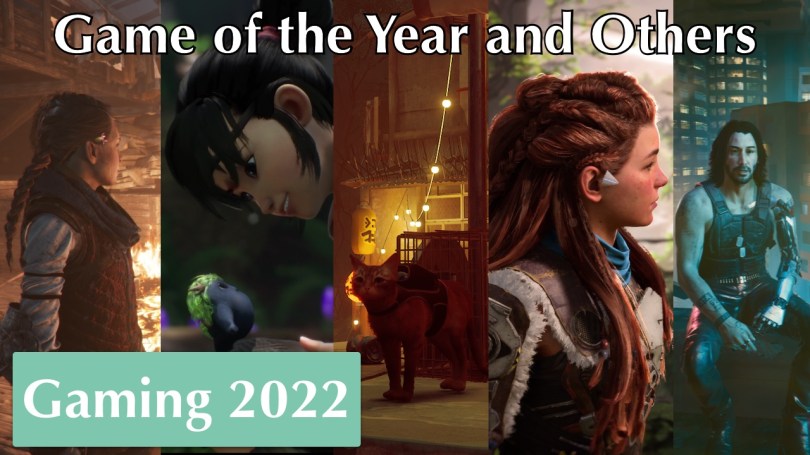
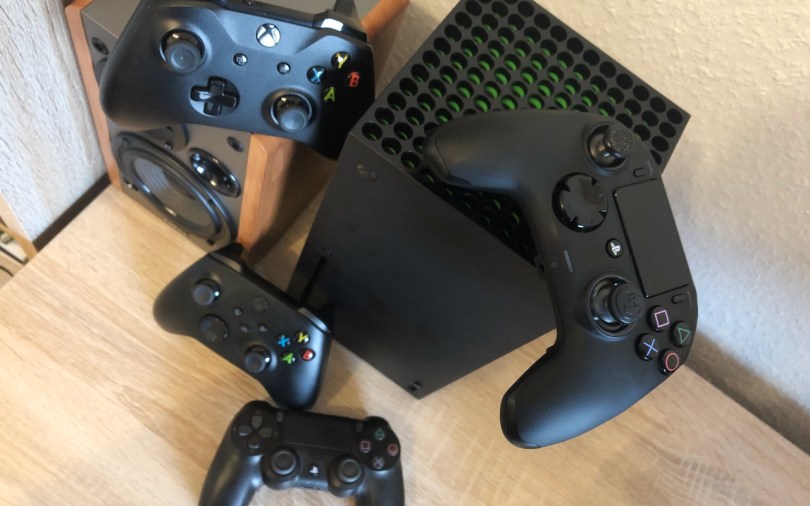
One of the “PC Master Race” issues with console gaming is the controls. I certainly was among them, and the more I play on a console, the more I keep coming back to this topic. 2021 was the first year where I spent the majority of my time playing on an Xbox Series console. Everything I tried during that year was okay, or it was still new enough to me that I could not differentiate between good and bad controls. On the PlayStation, I only played Horizon Zero Dawn, and I found it to be one of the best controller input implementations out there. In 2022, I have played fewer games in total in about the same period. Still, a higher percentage of them frustrated me with their implementation of analog-stick movement to the point where I was about to give up or actually gave up playing the game.
Why is it so hard for some developers to figure out an enjoyable controller feeling? Am I the only one noticing this, or are long-time console players just used to it? Let me take a step back and explain.
In the later parts of the review, I summarized the overall experience like this.
Horizon Zero Dawn feels excellent. It is one of those games that makes you feel empty once you beat it and put down the controller.
Both quotes express an extremely high bar of quality that Forbidden West is going up against. I am delighted that Guerrilla Games did not disappoint and delivered an incredible sequel that improves the experience in almost every aspect. Aloy’s second adventure has a couple of downsides resulting from modern Open World side activity design. However, compared to the exceptional setpieces you encounter during the main missions and the core gameplay, these are minor gripes you might choose just to ignore.
Forbidden West ups the ante further regarding the elements that matter to me in a modern (action) adventure game. It will be a benchmark in storytelling, character, and mission design. Zero Dawn was already excellent when it came to cutscenes. Lacking were only the dialogue sequences with other characters. Forbidden West changes this dramatically, and it looks and feels so much more organic now. Other key gameplay elements have also improved, like overriding Tallnecks or exploring Cauldrons. But more on that later.
Lucky me, I did not have to wait five years to enjoy this game as I did with Zero Dawn. However, were I inclined to get the absolute best experience, I probably would still have to hold out that long. A PlayStation 5 continues to be unbelievably hard to come by in Germany. But not to worry, there was no need for me to get into a crouching position again and hide in the shadows while I watched somebody play on YouTube. Horizon Forbidden West still looks and plays great on the PS4 Pro.
Keeping in tradition with my first Horizon review, I wrote the first words on April 23, 2022. I might actually get this review done before the year ends 😅.
Let me start this review with a big fat spoiler: Horizon Zero Dawn has one of the most beautiful worlds and world-lore ever conceived. The period that the authors cover is mind-blowing. Never has an apocalypse, the events that lead up to it, and what happened afterward been stretched so far apart as in Horizon Zero Dawn. It is called a post-post-apocalypse scenario for a reason.
Best. End-of-the-World Story. Ever.
There, I said it. Feels good. I had this one on my chest for a very long time while I was procrastinating instead of crafting this review as promised in My Year in Video Gaming 2021 story.
(Takes a deep breath <inhales> … <exhales> and starts from the beginning.)
As I start writing this review, February the 6th, 2022, Horizon Forbidden West is just around the corner. Five years earlier, also in February, Guerilla Games released a completely new franchise that became an immediate success. It was one of those games that are said to exist only on PlayStation – a narrative-driven single-player adventure with an incredible focus on detail, quality, and polish. My kind of jam. But there was a slight wrinkle, though. As a PC player that had no intention of purchasing any type of console, and Sony not yet being in the business of also releasing their flagship titles on PC meant there was no point in waiting for a port. What does a ravenous gamer do in such a situation? He carefully presses CTRL and sneaks into a dark corner, hiding and unable to be seen by other PC players. He then shamefully turns to a trusted YouTuber and watches the spectacle in absolute awe and with envious contempt for himself.
About five years later, the former greedy PC gamer has now turned to consoles for his fix. Consequently, it was about time to experience Horizon Zero Dawn for myself. I have raved about this masterpiece to my sister, and she ended up buying it but then sat on the PlayStation while it gathered dust. To satiate my hunger, one day, I grabbed my PS4 Pro in one hand, my sister in the other, tossed both in the trunk of my car, drove home, and we ended up enjoying the game together. Good things come to those who wait, and I have waited long.
(No PlayStations have been hurt in this depiction of events.)
Let me dive into the details in my usual manner and tell you what I liked about Horizon Zero Dawn and what elements were not so optimal.
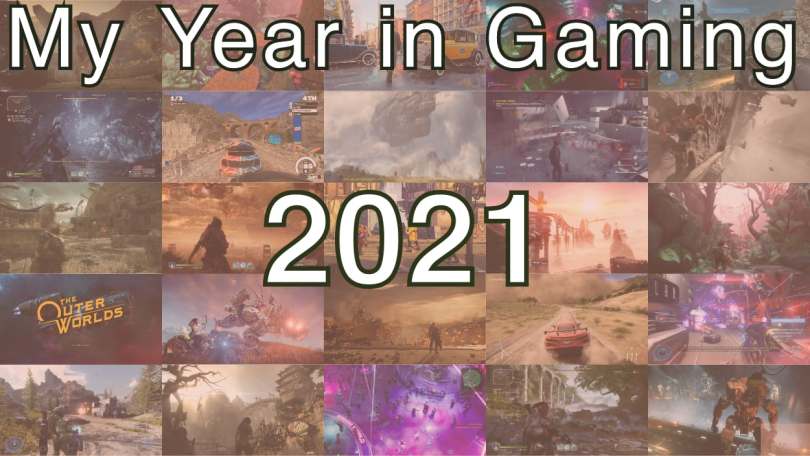
2021 has been a challenging year, for obvious reasons, but also in other personal aspects that are not part of this little essay. Despite all the trials and tribulations, I have probably never played so many games in just one year – some of them in Coop and others all on my lonesome. Many of them I finished, others I, or we, aborted. But not only that, I have also managed to transition from PC gaming to console gaming – a long-held goal of mine.
As always, I am pretty late to the party because I have trouble motivating myself to write stuff, despite having the ideas and mentally developing concepts for them. Much thinking, few doing. One of my 2021 issues.
(I am surprised I managed to get this huge Halo Infinite review out the door.)Here is how this will go. I am starting with a story about why I replaced my gaming PC with consoles and a laptop. Then I transition into my experience with said consoles, and I conclude this gaming year review with the list of games I have played in lonely-mode or Coop. Don’t worry. I didn’t go Halo Infinite on every game. I kept it short-ish because the list is astonishingly long.
When you look back at the history of video-based media, how many games
or movies come to your mind with such an iconic theme song that it
always evokes a particular feeling whenever you hear it? A theme that
you immediately recognize and that conjures specific scenes or
gameplay moments you are so fond of? Off the top of my head, I can
think of two: The Imperial March from Star Wars and Halo’s
invigorating battle soundtrack. Halo is back, infinitely better
than Halo 5, and along with it, its recognizable music. I suggest you
set the perfect mood and open the link above, and then come back and
read my review of Halo Infinite. Start from the beginning because I
linked directly to the battle music part (but that is also a good
choice).
Now, is it even worth getting in the mood? If you ask yourself, I hope
you do not mean my writing 😉. I hope you ask that question because
you are anxious for a good game but afraid you might get disappointed.
When I read and watched many reviews from known media outlets, I found
very different opinions and wasn’t sure what to think. IGN mainly had
positive things to say and was very upbeat in their Halo Infinite
podcast episode. In contrast, the Germany-based Golem.de
website found rather harsh words for some parts, mainly
storytelling and the new AI (more on that later). The most common
denominator among all of them was the excellent feeling combat.
Looking at the complete experience, I think I land somewhere in the
middle between Great and Mediocre, and if you are still curious, I
will tell you why.
Do you know the feeling that you occasionally get when watching a gameplay trailer, and you immediately want to get your hands on the game? Like, right now? This sensation does not come around too often for me, and two games managed to do just that last year. One was Outriders and the other one The Ascent, which I am discussing today. I am not sure what exactly did it for me, but probably because it reminded me of something I played in my youth. In 1999, a game named Expendable made the rounds, primarily due to its stunning visuals at the time. Back then, it demonstrated the power of a graphics feature called Environment Mapped Bump Mapping to enamor the game’s textures with depth information and more perceived detail. The core visuals will not excite anyone in 2021, but that game was full of effects and did not hold them back. Expandable still puts on quite a show.
Games like this are a rare breed and seem to catch my eye whenever one pops up. A more recent example of this type of game that I am aware of is Halo Spartan Assault and Halo Spartan Strike – of which I played the first one. Combine this with stunning visuals in a futuristic, gritty, cyberpunk-themed world, and you get The Ascent. Because it is 2021, no game can make do without some RPG elements. Thus, you get to create your character, level up, and collect loot along the way, making shooting stuff more enjoyable.
And enjoyable it is. Once you get to the point where your brain can cope with the twin-stick-shooting mechanics, and you start to both move and aim in the right direction, The Ascent begins to make a lot of fun – especially in Coop. I discovered how the game works with another player, which is always more motivating than figuring out weird concepts alone. After a while, it started to feel right, and I wanted to continue playing weekend after weekend until we had beaten the game – and that is a good sign.
Here is my report on The Ascent in Coop mode: the good, the bad, and the ugly.
It has been a long time since I have played a first-person shooter in
single-player mode. The last playthrough was probably the original
Half-Life as a Let’s Play on YouTube about three years ago (I expected
it to be longer, though). Since then, it has mainly been 3rd person
shooters or action adventures. The majority of 1st person shooting
games I have played are the Borderlands franchise and Counter-Strike
until version 1.6. There have been a couple of others, of course; big
names like Half-Life 2, Doom, Unreal (Tournament), Serious Sam, and so
on. But that was at a time I would now call my youth. I like the skill
aspect of shooters, but other than that, I have not found many that
got me interested in a way that made me want to continue to play them.
I have barely played through any of the previous games (Half-Life 2
being the exception 😉). In the here and now, I am looking for a
well-told story and character development. And by that, I mean the
main character’s personality and the relations the character has with
others, not a role-playing system.
I have heard many praises about the quality of Titanfall 2, despite it
not being a huge hit. When I discovered this game for a whopping 2.99€
in the Xbox game store, I figured why not try it out. Since I usually
try to write reviews for games I find noteworthy in a specific way, be
it good or bad, there must be something about Titanfall 2 that made me
mash some keys on my keyboard and publish it on the Internet. Is it a
Witcher 3 or a Battlefield 4? Curious?
The start of Q4 2020 was supposed to be an incredible time for PC
gamers – or gamers in general. Firstly, Microsoft and Sony released
their latest Next-Gen consoles, the Xbox Series X and S and the
PlayStation 5. Secondly, AMD and NVIDIA battled it out in the GPU
market, and AMD unleashed the Ryzen 5000 CPU family that ate Intel’s
10th generation for breakfast. And lunch. And supper, and dinner, and
as a snack in between. Unfortunately for Intel, the only thing the
11th generation of Core Processors can do is hold AMD’s beer. In
theory.
Excellent Hardware, No Stock, High Prices
I think by now, about six months later, we all know how things played
out. It is not about having the best performance anymore. Instead, it
is about who can get products on the shelves or into retailers’
warehouses so people can buy them. It seems like the price does not
even matter. Some affluent enthusiast gamers may be more willing to
overpay for their hobby, and first-time builders might not know any
better. I am neither in the first nor in the last category. I could
afford new PC hardware, but I am not willing to overpay a single Oren
for any of it. The reasons for these prices are manifold, and many
YouTubers discussed this very topic in many a video.
The story I want to tell you today is how all of that brought me into
Microsoft’s console hardware and gaming service arms. Well, I guess I
kind of already spoiled the reason: PC hardware is ridiculously
overpriced, let alone readily available to buy. But there is more to
it than that.
I recently purchased the smaller of the Xbox Series, and it came in a
bundle with three months of Game Pass Ultimate. As part of Game Pass
Ultimate, you get access to EA Play games and, therefore, some of the
Battlefield franchise. Since I have never played this game before, and
I was in the mood for a simple shooter, I wanted to try it out. I am
only interested in the single-player campaign and have no interest in
the multiplayer modes. Hence, I base my thoughts on the single-player
experience.
The idea of the introduction is not bad. You find yourself trapped in
a car with the rest of your squad. It is apparent that there was an
accident, and one of your buddies is badly injured or trapped and
cannot get out. The situation is intense because the car is sinking in
a lake or river or some other large body of water. Panic starts to
break out, especially since your leader wants you to leave him behind.
He hands you his handgun and orders you to shoot the windows so you
and your fellow soldiers can get out. They, on the other hand, do not
want to leave him behind. And from there, the game rewinds to where it
all began.
Germany-based company Crytek is best known for its Crysis and early
Far Cry games and the CryEngine technology. Ryse: Son of Rome is
probably not as well-known, and it certainly is not very popular. The
game’s Metacritic score is 61, and the user score is 6.8. The
biggest complaint I was able to ascertain was a lack of freedom and
extreme repetitiveness. While I cannot argue with that, I also see it
as a strength instead of a weakness. If you want to know why I
encourage you to continue reading.
If you are in the market for anything gaming PC or gaming laptop
related, chances are, you have come across the industry-wide trend of
RGB illuminated hardware and peripherals. Everything is RGB, from the
graphics card to the RAM, to your headset (because you can see the
lights when you wear it 🙄), and many, many more. I am not against RGB
lighting per se, but if you follow the industry as a PC hardware
enthusiast, it is evident that in some aspects, this has gone too far.
Quick side note: after a rant about RGB software, I will show
examples of using OpenRGB on Windows and Linux. If you are interested
in only that, skip the rant and scroll to the bottom.
The first two cases I had bought were before I became aware of all
the mass-market and niche options that existed at that time. Not only
have I learned about the DAN Case, NCase M1, and Streacom DA2, but
companies have released more cases during the past year. I’m
talking about the NZXT H1, the Cooler Master NR200, or, recently,
Phanteks’ second attempt at the Evolv Shift. Even Lian Li’s TU150
landed during that time, my current case. There are even so many more
cases, like the Louqe Ghost S1, the FormD T1,
Sliger SM560, and many more.
In a few aspects, the Lian Li TU150 is comparable to the NZXT H200.
One: for an ITX enclosure, it is on the bigger side. And two: it has
a similarly closed-off front. Other than that, they are pretty
different, though. In some areas, that is a good thing, and it is a
bad thing in others.
In the timeframe of just over a year, this is the fourth (!) computer
case that I have tried. Usually, it is the CPU or GPU that gets
replaced more often 😅 It is also my current case, which means I
can provide good pictures to visualize my thought process better.
In the third part of my road to the perfect mini ITX computer case,
things will get a bit weird. As you may have gathered from the title,
I will not talk about a mini ITX enclosure in this blog post. Quite
the opposite, in fact: the Fractal Design Meshify C is a full-sized
mid-tower ATX case.
You may now wonder why I suddenly had a change of heart and ditched a
big.SMALL™ case for a not-so-small big computer tower. Well, I was
surrendering to big graphics cards. Or, put the other way around, I
was annoyed that I had to search endlessly to find a fast and quiet,
and affordable two-slot graphics card model, only to fail ultimately.
But, let me not get ahead of myself and start from the beginning, the
same way I did for the previous two blog posts.
The second of the bunch is one of the stylish cases from NZXT, the
H200. While it is technically a mini ITX chassis, it is a large case
for that market segment. Just like the Fractal Design Core 500, it is
compatible with a wide range of hardware, making it the perfect
enclosure for price-conscious buyers. On top of that, it also is
beautiful.
Unfortunately, I do not have an image of a complete desk setup with
this case. Here is one with a good look at the internal layout and
installed hardware.