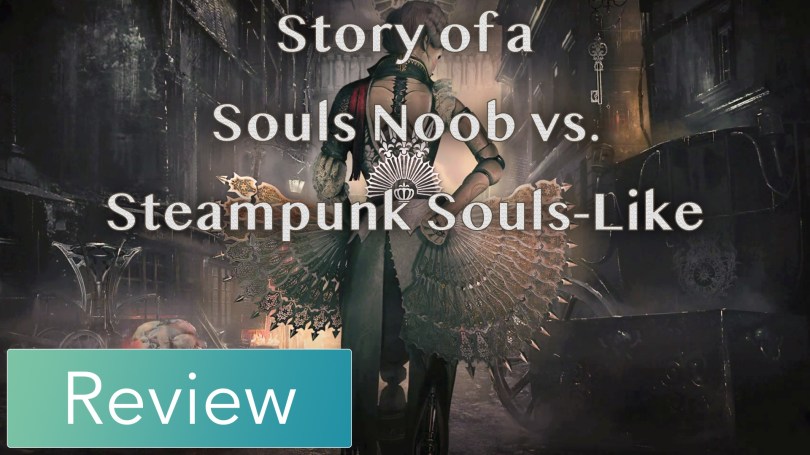
They are daunting and interesting at the same time. They are infamous for their mercilessness. In addition to the hard difficulty, these games also surprise players with seemingly unfair encounters. And yet, Souls games enjoy a cult following. But what’s the appeal? Is it only about the difficulty and the associated privilege to say, maybe even brag about having finished one of the most challenging types of games? Is it a status symbol, a badge of honor, when you beat the Dark Souls series or its contemporary counterparts? What has always been something special among core gamers has seemingly exploded since the overwhelming success of Elden Ring. Especially action-oriented alternatives are in abundance nowadays.
As someone who stays on top of the gaming news, I see all the trailers, watch reviews, and even tune in to streams. They all look cool, but playing myself has never crossed my mind. And that’s due to the difficulty, which is a huge deterrent.
But then I discovered Steelrising, a double-A Soulslike set in an alternate history version of France during the French Revolution. According to HowLongToBeat, the campaign supposedly wouldn’t overstay its welcome and, more importantly, the game featured a slider to adjust the amount of damage taken. Of course, the plan was to finish the game without any adjustments, like a real gamer. Since I expected to rack up a ton of deaths, I intended to spice things up by counting all of my mishaps to have a laugh at my expense at the end. So, I dived in and started recycling angry bots as the only sane Android in this hostile world.
As you might expect, I had to climb the learning curve at the beginning. Even though this was my second attempt at beating the game, I had to get used to the slower, more deliberate type of combat. My first try was quite some time ago, and I managed to get to around 20-30% through. Then life things happened, and the game was moved to the individual parts pile. Although I had some prior knowledge, muscle memory wasn’t part of it. I like it fast, and I’m impatient. Preferably, I’m always on the move doing something. It could be attacking or dodging. There’s no standing still. Changing my habits to avoid greediness was one of the biggest hurdles to overcome.
But Steelrising gave me enough time to adjust, although the first challenge in the form of a mini-boss didn’t take long to arrive. Unlike the first time, however, I found success much more quickly. Everything progressed at a faster pace this time around, and it took me a while to realize why. Meanwhile, I continued exploring the ruins of Paris, sorted bots by their individual pieces, and opened shortcuts to return to my current progression more easily. With every shortcut I found, I realized more and more another appealing trait of this genre: the level architecture.
Virtual Paris in the late 17th century was full of labyrinthine roads and alleyways. Danger lingered around every corner, just like items. Exploring the world was a core pillar of the game for a couple of reasons. Every free resource to lubricate ball joints (aka healing) or grenades to forcefully disassemble enemies is worth its weight in gold. You don’t have to spend resources to buy these things if you find ‘em. At the same time, exploration can literally open doors for you. Uncovering all the shortcuts is crucial when your Android runs out of gas. Otherwise, you’re forced all the way through treacherous and dangerous territory again to return to your body, starting from the last save point. It might sound strange, but it was a satisfying feeling to open a door, take a confused look around, only to realize where I was a moment later. The levels were a highlight. In parts, the locations also reminded me of A Plague Tale: Innocence. Dark, bleak, run down, dangerous.
Of course, at some point, it was time. When I realized where I was, the only thing that came to my mind was: “Uh, oh… I know what’s about to happen”. The first real test of skill. The first real boss, a so-called titan. In the middle of the Louvre. This monstrosity really got to me in my first attempt. My sister had to check for the best strategy with a still AI-free Google search. After about 10-15 long, arduous, and also brief attempts, I had prevailed. With this experience in the back of my mind, I faced the Selenite of the Louvre. You have no idea how great it felt to set that monstrosity straight for a second time and turn it into old metal. In just two attempts.
At this point, I slowly began to realize why success came so much more easily this time around. In my first attempt, I played as a tank, a warrior packing a big punch. After all, Soulslikes are said to be easier when playing a strength build. This time, however, I went with agility, and I think it was a smart move, given my playstyle. My character was more responsive and attacked much quicker without long wind-ups. I may not have inflicted the most damage per hit, but I preferred defeating enemies by a thousand cuts compared to waiting for a minute just for the attack animation. It matched my impatient playstyle so much better. Filled with pride, self-confidence, and motivation, I continued forward as a professional scrap metal recycler, hacking through the levels.
Throughout the course of the game, the enemy variety didn’t change much. A few bots learned some new tricks, but at its core, Steelrising only confronted me with a limited number of walking combat scrap. Critics and gaming connoisseurs might scoff at that, but it’s perfect for noobs like me. I wasn’t overwhelmed by the variety all the time. But don’t interpret that as if it were never dicey. There were so many times when I barely scraped by on just a drop of oil. Interestingly enough, the common run-of-the-mill bots were the most dangerous foes, particularly during fights in tight spaces. Exploring the levels was the main cause of my deaths, not the giant bosses. While all of them were super cool designs with crazy looking skills, most turned out to be nothing more than oversized toys that rarely pushed me beyond my limits. I dismantled most of them like a small child picks apart the Lego Technic collection of their older siblings.
What turned out to be more frustrating than difficult bosses were interactions with the characters I rescued from them. Steelrising spun an interesting tale full of political intrigue with a bit of supernatural elements as lubricant on top. What could have been super exciting was diluted by boring, trivial drama. Games that focus on characters and their interactions are usually my jam. Unfortunately, Steelrising’s authors went so far overboard that even Gossip Girl would blush with embarrassment. After roughly half of the game, I spent so much time with unnecessary conversations that I started to lose steam. Early in the game, side-quests were more of an occasional thing. But now I was inundated with something akin to a Santa Claus wishlist for a pile of toy bots. Out of nowhere and without any prior hint, I had about 10 side quests to do.
Pacing was in shambles. Suddenly, Steelrising made me complete a checklist and report back to privileged, arrogant divas. And the worst part of it: many of the quests made total sense given the circumstances. It was just too much at once, wrapped in a soap opera that produced more foam than air in a bot’s hydraulic servo lines. Toward the end, I caught myself frustratingly beating up the skip button on my controller on one occasion to escape the pseudo-emotional babbling. The devs hammed it up considerably. Half of it would have been enough, because in the end, it didn’t matter much anyway. Although the story had potential, I didn’t shed a single drop of coolant for any of the characters. It wasn’t about the pompous wigs that were hiding behind thick walls. The levels and the gameplay were the stars of the show. Luckily, these subpar elements didn’t dominate the game. The act of exploration and the great-feeling combat were unchanged and remained enjoyable. It just so happened that Steelrising tried to be something for a moment that it wasn’t.
You see, Soulslike games are a power fantasy where you grow your character to become ever more capable. You know, add a new downpipe, a better intercooler and air intake, and modify the software for more output. That concept hinges on the fact that the game regularly drops increasingly stronger gear. Which it did… and did not. Itemization was very unsatisfying. Once I invested in the first couple of upgrades of my “reverse iFixit kit”, a weapon I found very early in the game, nothing else focused on agility ever came close. So, of the around 20 hours I spent disassembling robots, 19 of them were with essentially the same primary weapon. No other attitude adjuster that dropped improved my build. Not even late-game. The same can be said for armor, only without the upgrading functionality. This was the second weakness of Steelrising, alongside the petty squabbles, which slightly impacted my overall enjoyment of the game.
And it’s a shame, really. At its core, Steelrising was a very solid Soulslike that I’d especially recommend to beginners. It’s a great entry into the world of merciless action games that struggles toward the middle with a few pacing issues, which you can skip over if you’re all about the action. Because the action is good, like the levels it takes place in.
At the end of my roughly 20-hour journey, my death counter displayed the number 24. That’s 21 involuntary retries less than during my first attempt after merely 20-30% through the game.
Famous Last Words
I deliberately wrote this review as a story rather than a chapter-focused summary of features and functions. Nevertheless, I’d also like to discuss a few topics that didn’t gel with that concept.
First of all, Steelrising still looks great in 2026, and the performance was solid. Some levels offer great vistas over Paris, and the levels themselves are very detailed and dense. I played on Linux at the highest settings with ray tracing enabled. FSR4 Performance upscaling allowed me to play at 4K without issues, or at 1440p with Quality upscaling. The game only supports DLSS and a spatial upscaler. Therefore, I employed Optiscaler to inject FSR and the environment variable PROTON_FSR4_UPGRADE to enable FSR4 support in Proton. Image quality was very good during normal gameplay, and only cutscenes with heavy depth-of-field effects showed minor artifacts. But that’s a challenge for any upscaling tech. I’m picky with such things, and it didn’t bother me. I also couldn’t notice any typical Unreal 4 stutters.
During my adventure, I came across some bugs, and I don’t mean the tiny bots that lay eggs to buff the bigger ones. Textures wouldn’t load occasionally, making those areas look soft and muddy. Reloading a save usually fixed that. More annoying were bugs with the voice acting that randomly cut out. You can talk to citizens hiding in their homes, just like in Bloodborne. But sometimes, the main character wouldn’t talk, sometimes the citizens, sometimes both, never predictably. Although I had subtitles enabled, I missed many conversations. By the time I noticed that something was off, I had already lost the thread. I haven’t verified if this also happens on Windows, but I’m pretty confident that it’s a general bug and not related to Proton translation.
I’d also like to highlight once more that the devs went against the stream and included a difficulty setting, even though Steelrising is rather easy for a Soulslike. I find this to be an important accessibility option, despite it being considered sacrilege in this genre. Stellar Blade, which I recently tested, also has a Story Mode, and Lies of P received a difficulty setting in one of its later patches. I hope this trend continues.
Now, if I haven’t been clear earlier, I’d like to explicitly reiterate that Steelrising is a good game with a few weaknesses. I had a lot of fun, and it’s a great entry for beginners to the Souls genre. Does that make me ready for Elden Ring now? I highly doubt it. Elden Ring is a different beast. An over-one-hundred-hour beast. A much, much more difficult beast. But if I’m honest, I’m tempted.
 The Gameslinger