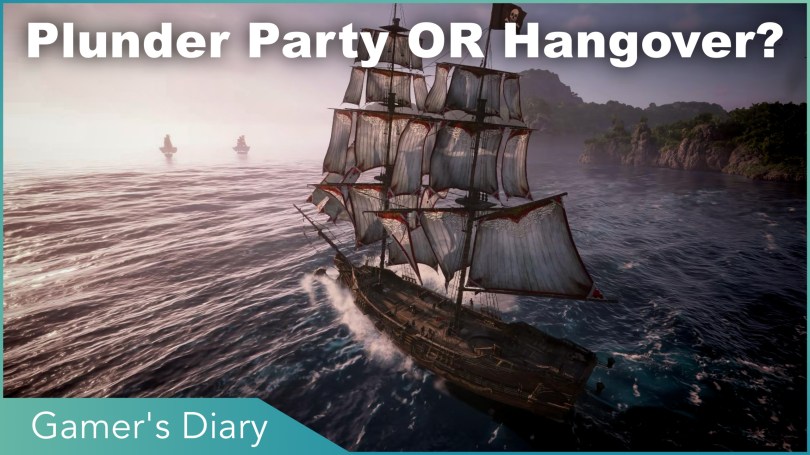
I want to start this blog post with what I believe is a somewhat controversial statement: I prefer Assassin’s Creed Shadows over Black Flag.
Now, before you pick up your pitchforks and torches and start searching for me, I’d like to kindly and slightly afraid remind you that this behavior belongs in Geralt’s world, not the seven seas.
(Awkward silence. Crickets chirping.)
So, how did I come to this conclusion, given that I didn’t exactly rave about AC Shadows? Stay a while and listen.
(Wait, also wrong universe.)
Edward’s piradventure was bombarded from several sides. Some have been plaguing the Assassin’s Creed series for a while now, including Shadows, and others that I didn’t encounter in Shadows.
My first version of this script consisted of an about one-thousand-word rant about some technical aspects of the game. And by that, I don’t mean graphics, performance, and stuff like that. That was flawless. What I’m talking about are the supporting systems like the HUD, controls, and camera, and I will complain about some of it. They were a part of my experience after all. On the other hand, everyone perceives this differently, and I wanted to focus on more important topics.
I also have a German version of this video.
My History With Assassin’s Creed
But before I start complaining like your typical German citizen, I want to establish a bit of context about my experience with Assassin’s Creed games. That should give you an idea where I’m coming from.
If I recall correctly, the gigantic AC Odyssey was my first adventure, which I finished twice. During my second playthrough, I actually explored all islands, looted every camp and fortress, and completed all quests I could find. After that came Origins, which I also finished, albeit less thoroughly, a little bit of Valhalla, some Syndicate, and Shadows not too long ago. Apart from Syndicate, which I only played for a couple of hours, I’m only acquainted with the titles that came before Origins based on YouTube videos. The stories of the first games exist as a form of „movie“ on YouTube where the cutscenes and adjacent gameplay have been edited into one big video. This is what I know of the pre-RPG era of AC games. To me, the older titles seem much more linear in structure than the modern versions, while still offering a large open world. Given this expectation, I started my plundering journey on the seven seas.
Technical Difficulties
Let’s begin with the technical issues I encountered before discussing the gameplay and the story. The way the camera and parkour system worked really put me in a drunk-in-a-bar fight mood.
I can forgive the camera being way too close to Edward, despite the field-of-view slider being set to max. The modern God of War games aren’t much better in this aspect either. Nevertheless, I would have preferred a camera that’s farther away.
What infuriated me the most was how often the game yanked control of the camera away from me. Sometimes it whipped around like a drunkard, making me dizzy, only to end up pointing somewhere useless after the animation had finished. By that, I mean finishers, stealth kills, or just leaping into the ocean. I’m not interested in looking at the ocean floor if the next quest is on the island in front of me. Also, once Edward was in the water, I couldn’t look up anymore. Why? Can people no longer move their head while swimming?
I hope I remember correctly that earlier AC titles did not exhibit this problem and at least allowed me to move the camera freely during combat animations, and even pointed to where I was looking after the finisher or stealth kill concluded.
Oh, and the worst of it all: petting cats or dogs also fixes the camera position. Almost always, Edward was in the way of the furry friend, or all I ever saw was a cat’s butt.
But that’s not all. The menus weren’t any better. Why did the world map always – and I mean every single time – open zoomed out as far as possible? Going shopping was as fun as rotting in a prison like a pirate. Buying upgrades or interacting with regular shops was a drag because the animations took so long to finish that I couldn’t continue doing what I wanted. All the bloody slow and pointless transitions were a waste of time.
(Bloody slow is a notion we’ll come back to later, by the way.)
The parkour system marks the end of my complaint tour. My goodness, did that get on my nerves. Edward frequently got stuck on objects and ledges, resulting in combat when stealth was my intention. Or Edward jumped onto something when I didn’t want him to. In true pirate fashion, the system did as it pleased on more than one occasion. I cannot count how often Edward was glued to crates, walls, or ledges as if they were laced with adhesive. He just wouldn’t get off. And other times Edward ejected himself from fortresses or other larger structures when I didn’t want to jump. As a result, I had to go back to the beginning and start the tedious climb once again.
(Cardio workout?)
Granted, I’m probably making this sound worse than it actually was. After all, that’s how complaining works. Exaggerate the heck out of it. Overall, the system worked… fine. But more often than never it did something dumb.
Generally, I don’t like to focus on stuff like that in my gamer’s diaries. It’s just that the Black Flag remake really irritated me with these things.
Gamer’s Diary
I don’t know where, but somewhere I picked up the saying that „everything’s better with pirates“. Following that logic, Assassin’s Creed Black Flag Resynced must be the perfect game. Looking at the Metacritic score, the original game received a good reception, and the remake received the same score from gamers, at least. For me, it was the first Assassin’s Creed game I finished that did not follow the modern RPG formula, and I was excited for a more linear and cohesive storytelling with a bit of side content.
But there is a catch: the naval combat wasn’t my favorite game mechanic in AC Odyssey. Still, I had some hope that the water canon ball was more fun here since everybody was so fond of it. Well… it wasn’t. Turns out that I still like water vehicles as much as I like aerial or space travel – not to mention combat.
(Sarcasm)
In short: Everything that’s not taking place on solid ground is just too sluggish and imprecise for my liking. Imagine you’re trying to play Counter-Strike on a streaming service, with frame generation enabled at 60 FPS, using a controller.
And with that, a core gameplay element became a killjoy. Since the start of the game focused a bit more on naval battles and cannon fire compared to stealth and poking enemies with a hidden pointy piece of sharp metal, the first hours were more frustrating than fun for me. Even exploring the world wasn’t a good time because traveling from A to B just took soooo fishing loooong. Uncovering all that the map has to offer is usually one of the first things I do in a game like this. AC Shadows, being a lot larger, was still more enjoyable to explore one horseback than crawling across the open sea on the Jackdaw. Which brings us right back to the notion of bloody slow. Those were the dullest moments of the entire game. Even the content-less cities of the Mafia games were a lot more exciting to drive through. And that’s unfortunate because Black Flag simulated seafaring incredibly well. It just so happened to be as dynamic as a highly pregnant sea cow.
Thankfully, a freely configurable difficulty setting let me disarm the naval combat scenarios, making them tolerable for me. Thank you, Ubisoft! It didn’t help with the long-winded expeditions across the open sea, but I worked around that by using the fast-travel system to get to the closest harbor on the map and hop on my ship from there. Nevertheless, I still wasted one to two hours of my life waiting for my ship to reach the target.
Storytelling, on the other hand, took on a different pace. Now, the narrative in modern Assassin’s Creed games suffers from Ubisoft’s disjointed formula. Black Flag’s linear story felt choppy because of the often-long travel times, which somehow took the wind out of its sails, despite actually moving rather quickly in many respects.
The story of a band of pirates striving to build their own free republic combined with the conflict between Assassins and Templars has a lot of potential. Sadly, there’s still the feared “but“ coming. The main story ran for around 20 hours, and given that long a runtime, I found the storytelling quite superficial. It included many people who all had some history with one another, but the game never explained why I should care about these pirates and pirate ladies. More often than not, the tale moved briskly from one scenario to another without ever establishing a definitive relationship among the participants. Only after I reached about 70% completion did something emotional happen. And even then I had a hard time feeling compassionate. For some reason, the game leapfrogged from event to event in ten to twenty minutes, leaving me confused and with questions. I wasn’t sure whether what I just saw was canon or a Far Cry-style high-as-a-kite hallucination.
It’s not like there was a lack of charismatic and interesting people. The game just didn’t give itself enough time to develop memorable personalities. I learned the most about the protagonist Edward, but unfortunately, he was an insufferable, narrow-minded drunk incapable of evolving. And the one time he actually did change, it was an instant one-eighty that happened during the questionable baked-or-not-baked sequence that crammed way too much content in as little time as possible. What I would have liked to see was a gradual evolution of his character.
As a result, I did not develop any connection to the characters or the world, and most of the events didn’t impact me in the slightest. This turned the game into simple yet entertaining popcorn cinema without any depth.
Famous Last Naval Battle
Before I end this journey, I’d like to bring this all together and look at it at a higher level. Black Flag Resynced is not a bad game. Far from it.
If you enjoy the seafaring and naval combat, it changes the whole experience for you. For me, it was an obstacle that stood between me and the fun parts. Which did exist. Once the missions focused on stealth and exploration, the turns had tabled, and I felt right at home. It was the good ol’ comfortable gameplay we all know – ignoring the camera. The stealth puzzle was entertaining and slightly more challenging than in AC Shadows. The enemies weren’t as stupid as in other AC titles. And as is customary for an Assassin’s Creed game, the story presentation also was very engaging. I wanted to know how Edward’s and his crew’s story concluded, and that’s what kept me coming back.
But as I alluded to earlier, the game wasn’t able to fully get its hook into me. As beautiful as Ubisoft’s Anvil Engine presented the world, it failed to immerse me. As usual, the map was way too big to have memorable content everywhere. Ultimately, I only followed quest markers and worked through the quest step checklist. I couldn’t have cared less where I was, and it’s a shame.
Now to come back to the beginning at the end.
(Makes sense, right?)
Many of the pain points of Assassin’s Creed Black Flag also apply to Shadows. And vice versa. That’s the problem of Ubisoft’s open world formula.
What I preferred in Shadows was the lack of naval combat and the ability to explore the world on foot or horseback. I also like to believe I had fewer complaints about the camera and parkour system. However, I’m one hundred percent certain about me liking Naoe and Yasuke way more than Edward, especially how their characters developed throughout their journey.
And that’s why I prefer AC Shadows over Black Flag.
Thank you for reading. Please don’t be discouraged by my complaints and, instead, enjoy the virtual privateering wherever you are.
 The Gameslinger