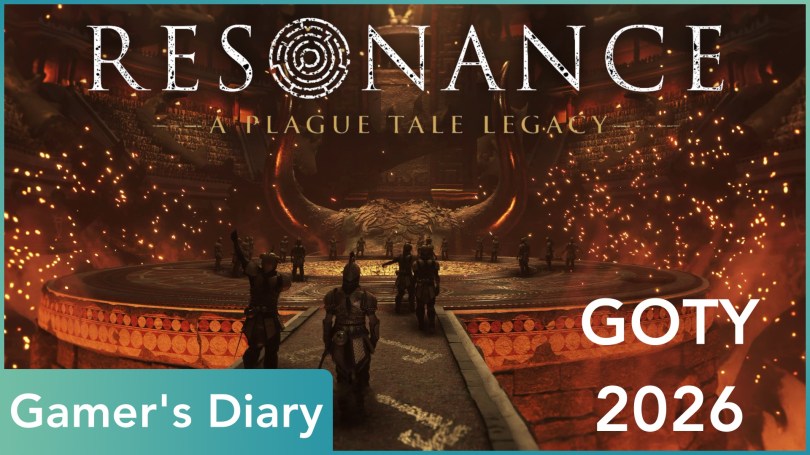
Even before the game’s reveal trailer could give away what the game actually is, I immediately recognized the visual style as A Plague Tale’s. My interest was piqued right away. The first gameplay footage instantly caught my attention because it was much faster and more offensive, with no sneaking around. I was sold right away, and with a bit of a delay, I treated myself to a revocable license and started my adventure. Although I watched a review between the release and my purchase – not really remembering the verdict and the content at all, now that I think about it – I was surprised by what I experienced. I’m honestly not sure what I expected besides more actiony sword combat, but certainly not what eventually happened. Looking back a bit at the complete A Plague Tale franchise, though, and its general tone, it kinda makes sense.
Imagine this: some of the authors met at a filing cabinet where they store variations of traumas and debated which one to use. Then the lead author walked up to the cabinet, took the whole thing, and turned it into a theme park full of emotionally damaging rides.
Before I continue, let me issue a slight spoiler warning. I’m not discussing any plot specifics, but to explain where I’m coming from, I might leave a few breadcrumbs that could hint at what’s happening in the game. So, if you want to enjoy it without any prior knowledge, you’d better stop reading now.
I also have a German version of this video.
Diary
Sophia’s past is barely less tragic than Hugo’s and Amicia’s. Her trauma already starts in her early childhood in the very first scene of the game. Asobo instantly laid the groundwork for what was to come.
What’s devious about that first scene is that the game immediately afterward continues in a very lighthearted manner. But as is often the case in Plague Tale games, the joyous moments don’t last for very long. I only properly realized this after beating the game and continuing to process it. Once you start the real adventure of exploring this mysterious island with a companion, it’s really easy to forget the tragic introduction. All of a sudden, the game plays like Uncharted set in medieval times, without firearms. And it was an absolute blast. Resonance pivoted around its various gameplay elements of exploration, combat, story, and puzzles very nicely and created a diversified experience. I found the balance between all of these elements very successful, and nothing overstayed its welcome. As somebody who doesn’t quite like puzzles, I can appreciate that. I didn’t have to take notes due to their complexity, nor could I just solve them on the side. Occasionally, my remaining brain cells did have to work together to figure something out, and the game never just blurted out the solution.
I’m of a similarly high opinion of the game’s character work. From my perspective, all characters were complex and presented in a very believable way. And that’s all thanks to the incredible cutscenes and the walk-and-talk moments during exploration and other gameplay moments. Each important person had a distinct personality, which made the events throughout the story even more emotional. There was no simple black-and-white.
I spent most of my time with Sophia and Leni, who were a dynamic duo. They clearly had a great connection, and they kept me entertained with their playful banter and candid, authentic commentary and reflections on what was going on. I quickly started to care about them, and consequently, I also cared about what happened to them. But it wasn’t just the two of them. Even the purported antagonist had more going on than what’s visible on the surface.
While writing this post, I played through A Plague Tale: Requiem and noticed several parallels.
That’s where Asobo’s authors showed far higher quality than those from Ubisoft, who were responsible for AC Black Flag. Emotional scenes in that game barely touched me because I didn’t care much about the characters, and the way they were presented was plain bad.
As I already said, the lighthearted moments didn’t last forever. What felt like Uncharted for the longest time turned more and more into a form of horror game, where brutal combat served as a release of tension between running and hiding from a terrifying monster. It also didn’t help that the story picked up considerably and the trauma theme park started revealing its main attractions. There were several moments that left me speechless, and I wondered if the team at Asobo was munching on cotton candy dipped in wine or other psychedelics.
As deranged as it may sound, but that’s why Resonance spoke to me and left a lasting impression. Had it been just a generic action game with maybe an interesting narrative but without all of the personal, sad events, it would not have resonated as much.
(I had to use the pun at some point.)
Because the protagonists were important to me, the story was engaging, and the gameplay brought it all together very nicely, Asobo Studio created one of the best games of 2026 for me.
And I haven’t even touched on how the characters were brought to life by incredible actors. Asobo has already proven it has a knack for finding amazing talent in previous A Plague Tale titles, and that trend continued here. Let me tell you, I haven’t heard such gut-wrenching screaming in a long while.
But it doesn’t stop there. They also amped up facial animations to a great extent, showed a lot of attention to detail in the world, and even just idle animations. And let me tell you about the music and the unbelievable setpieces. Goosebumps. Every time. I definitely noticed some Remedy DNA more than once, and that’s saying something.
Taken together, these pieces formed a rollercoaster of emotions.
Famous Last Therapy
If you’re not yet fed up with the game, I strongly recommend the playthrough of Sophia’s actress. It turns out that she’s also a streamer and uploads her videos to YouTube. Her content provides so much interesting behind-the-scenes information.
Summarizing it in plain words, I must say that I’m impressed with Asobos new Adventure without Amicia. I’m super happy about the step to try something new and create an action-oriented game instead of relying primarily on stealth. I had so much more fun than in Requiem, which I’m about to finish. Honestly, I had hoped it would be more of the easy-going exploration-combat-puzzle loop all the way through. I’m a simpleton and creature of habit after all. Instead, the game designers and authors showed their creativity and continued evolving the gameplay loop throughout the game. It never got to a point where it was overly complex, but it also didn’t stagnate, and that’s what made the game – together with the story – an experience.
However, there is one thing that didn’t make much sense to me. The game insisted the whole time that a certain artifact was required for achieving progress on the island. Apparently, without it, one couldn’t complete trials and open gates. But why, then, was it always the case that enemies managed to get ahead of me every time? Even toward the end, during the last trials with another companion, conversations suggested that earlier expeditions had actually gotten quite far. This made no sense given what was said early on. Either I missed important clues, or the authors stretched the logic for a better, more fun gameplay experience by putting it on a rack in the theme park for emotional torture.
It didn’t ruin anything about the game for me. That fact just continuously screamed in my face.
Resonance: A Plague Tale Legacy is proof to me that a thrilling game can still be relatively short and still cost 60 bucks.
(Around 15 hours.)
I prefer not being inundated with pointless baggage that only stretches the playtime to silence fusspots. I’d rather enjoy a short and intense adventure that leaves a mark. And that’s exactly what Resonance did.
Sophia’s adventure is at the very top of my personal game-of-the-year list, and I don’t anticipate any other title I still want to play having any impact on it.
Thank you for your time. I hope your trip to a theme park is a fun one instead of traumatic, wherever you are.

